
OSINT: Research on the New BMW IDC EVO Platform
BMW recently revealed the BMW iX3 and i3 Sedan, some of their latest vehicles based on their new “Neue Klasse” platform/architecture. Peeking at photos of the new interior, I couldn’t help but notice: They seem to have a new infotainment system!
The latest cars have a system that includes four displays (three panoramic displays embedded into the dashboard and one tablet-style one in the center), something that’s brand new to the latest generation of vehicles!
This post is a deep dive into these new infotainment systems, attempting to answer:
What the heck is their new infotainment system?
Does it use new hardware?
A new OS?
Are there any teardown pics online? (spoiler alert: yes)
Off we go, deep dive time!
(If you want to skip to the juicy details, the device teardown photos start at the heading “Internal Device Photos - IDCEVO-EES25”)
BMW’s Official Info
First things first: a photo of the latest BMW interior, featuring the new “BMW Panoramic Vision” displays:
The BMW website wasn’t a huge help, but they did have some press photos showing off the new infotainment system.
I started my search on the BMW website, but found limited information. Apparently their new infotainment OS is known as “Operating System X”, which I suppose is essentially just “iDrive 10”. (It seems like they’re doing the iPhone thing, where they went from number-based models to the iPhone X)
The BMW website offered some interesting information about it:
The new OSX is developed entirely in-house at BMW
It’s based on the Android Open Source Project (AOSP) software stack
“Third-party content remains fully and seamlessly integrated and will continue to open up a wide range of streaming, gaming, and infotainment oferings in the future.”
This is an interesting new development: a whole new BMW-original AOSP-based OS to poke at! That being said, there was no information about hardware vendors or specs, so I had to do some digging.
Digging for FCC Filings
If you aren’t familiar with FCC filings, a quick blurb to bring you up to speed:
Electronic devices in the US must undergo the Federal Communications Commission (FCC) registration program. In this program, device manufacturers submit test results and evidence that their devices meet and adhere to all US laws pertaining to radio emissions, interference, etc.
As part of this, device manufacturers almost always submit interesting documents: a user manual, external and internal device photos, test results, and even photos of their FCC compliance test setups! These FCC listings have lots of juicy information if you’re curious about what new devices look like.
As such, this makes a great first stop when you’re looking for information about new automotive devices. Infotainment systems commonly have WiFi, Bluetooth, and Cellular RF communications that are all subject to FCC requirements, and as such, mean that the device undergoes the FCC registration process and is assigned an FCC ID!
Since I knew Harman developed many of BMW’s infotainment platforms in the past (such as the BMW NBT, NBT EVO, MGU22, and IDC23H), I decided to start by taking a peek at their FCC filings. This is as easy as going to the FCC website (or aggregator like fccid.io) and querying for “Harman” (technically “Harman Becker Automotive Systems”), quickly revealing that their FCC Grantee Code is “T8G”.
Harman makes modules for a number of different OEMs, but these two “IDC”-prefixed listings looked very BMW-like…
A quick poke through Harman’s recent FCC filings and, sure enough, we see a new FCC filing for an “Automotive Infotainment System IDC” filed on 2026-04-01! This is promising - the previous generation of BMW’s infotainment systems was the IDC23H, so it would be no surprise if the newest generation also carried the “IDC” moniker.
Harman’s IDCEVO-EES25 FCC Filing
Out of the two Harman FCC listings, I decided to start with the “IDCEVO-EES25” filing first, since it was filed for back on 2026-04-01.
The FCC ID in question is: T8GIDCEVOEES25
The quick high-level info for their FCC filing:
Target Market: North America
Model: IDCEVO-EES25
Alternatively: IDCEVO-CDE
FCC ID: T8GIDCEVOEES25
IC: 6434A-IDCEVOEES25
Device Variants
Interestingly, this FCC filing has a few different model names inside. They refer to both a “IDCEVO-EES25”, as well as an “IDCEVO-CDE”. In the main manual, the IDCEVO-EES25 is called the “Infotainment Domain Controller EVO”. In one of the other user manuals, they refer to the IDCEVO-CDE as the “Infotainment Domain Controller EVO-CoDriver Entertainment” (I guess that’s what “CDE” stands for, “CoDriver Entertainment”).
Not only that, but there also seem to be multiple variants for each model. The FCC listing specifically calls out three different variants:
B504 IDCEVO
B505 IDCEVO
B506 IDCEVO
These seem to relate to different trim levels or regions of the device, each with different features. These identifiers seem to be the “Type No.” listed on the front label of the unit, as shown below:
This is far from the first time BMW and Harman have done this - their old NBT, NBT EVO, MGU, and IDC units all featured “HB Bxxx” type identifiers as “sub-models” of each unit. As an example, the IDC23H teardown I did was specifically the “HB B423” variant.
Also, a quick side note about Harman FCC practices before we move on. Do you see that “Laird”-brand EMI shielding tape underneath the front sticker? Harman seems to cut a hole in their modules for debug port access during development, but then later covers it with EMI shielding tape to get proper emissions readings for their FCC testing. So if you look at the internal PCB photos of the device, I bet you the debug header is placed in the center of the PCB, right where that tape is covering :D Not really important, but a fun detail to look out for on Harman-developed devices.
Anyway, onward! The rear I/O of the devices gives an obvious first difference between each unit:
The B504 device seems to be the “base model”. In this listing, it’s shown with:
BT/WLAN (black) - Bluetooth and WiFi antennas
USB (dark blue) - USB connectivity (phone, USB hub, etc.)
CID (magenta) - Central Information Display
PHUD (brown) - “Panoramic Heads-Up Display”, possibly? Not 100% confident
1G BASET1 (black) - 1 Gigabit Automotive Ethernet
Main device harness (black) - BMW’s 16-pin infotainment connector, seems identical to the MGU22 and IDC23’s connector at first glance.
The B505 device is the next level up - in addition to the base B504 I/O, it includes:
ETC JP (green) - likely for a Japanese ETC toll pass
HUD (white) - A standard HUD connector, in addition to the PHUD connector
The B506 device is almost the same as the B505, just with one additional connector:
100 BASET1 (beige) - 100 Megabit Automotive Ethernet (100BASE-T1), the same NanoMQS connector used on the IDC23.
Overall, some interesting device differences - lets see what it looks like under the hood!
Internal Device Photos - IDCEVO-EES25
I know it says “Confidential”, but I promise it isn’t - they uploaded it to their public FCC filing, lol.
Digging into the FCC filing, Harman has included the required internal device photos, so we can learn a little bit about the device specs! The PCB looks much simpler than the previous IDC23H unit, with no separate APIX daughterboard.
This photo is of the B506 variant’s PCB, to be specific.
They’ve also apparently moved away from Qualcomm processors, using a Samsung V720B95 SoC instead! This is Samsung’s relatively new “Exynos Auto v7” platform, where BMW seems to be the first major OEM implementing the platform (at least, from what I could find in news reports around the net).
This photo has much clearer IC markings!
While it’s hard to get a close look at the SoC in the US FCC ID listings, the Japanese MIC Giteki database has slightly clearer photos, which make reading the engravings on them a breeze. Here we can see that the Samsung SoC is flanked by dual Micron LPDDR5X modules. These modules have 8GB of RAM each, for a total of 16GB for the SoC.
Other board features include this NXP/Freescale FS32K processor - I thiiink it might say FS32K144? I feel like the full reading is “FS32K144UAVL4” - but it’s really hard to tell at this low of a resolution.
If the IC’s markings do in fact read “S32K144”, it would make sense: NXP’s S32K144 family is a line of general purpose ARM Cortex-M4F automotive MCUs from NXP (family datasheet here), featuring easy CAN-FD and LIN connectivity. It’s possible this is being used as some sort of vehicle I/O or “interface” processor, handling things like CAN and LIN communications with the wider vehicle buses. This would make it similar in role to the Renesas V850 and RH850 processors seen on older BMW/Harman infotainment units.
The bottom side of the IDC EVO B506’s PCB
Looking at the bottom of the device’s PCB, a few cool things jump out. On the left side of the board, the two identical ICs are both Infineon CYW89570 chips. Infineon calls these chips “2×2 Wi-Fi 6/6E and Bluetooth 6.0 Combo for Automotive Applications” - a pretty straightforward name, these allow the head unit to have WiFi and Bluetooth capabilities. As for why there are two of them? I’m not entirely sure… possibly to support multiple concurrent WiFi or Bluetooth connections, or slight differences in purpose - maybe one is for WiFi-based updates and the other is for the driver’s phone and hotspot, something like that? Not sure!
Moving towards the top of the board, we can see the Inova APiX 3 IC. These are dedicated ICs used for transmitting image data from the module to the screens. The main APiX 3 processor found on the IDC EVO (the Inova INAP597TAQ) transmits up to FOUR DisplayPort 1.4a video signals, and even supports HDCP for copy protection. The B505 and B506 have an additional APiX 3 IC, the INAP565TAQ, which is slightly lower end - it only runs a single MIPI DSI (Display Serial Interface) video stream, with no HDCP support.
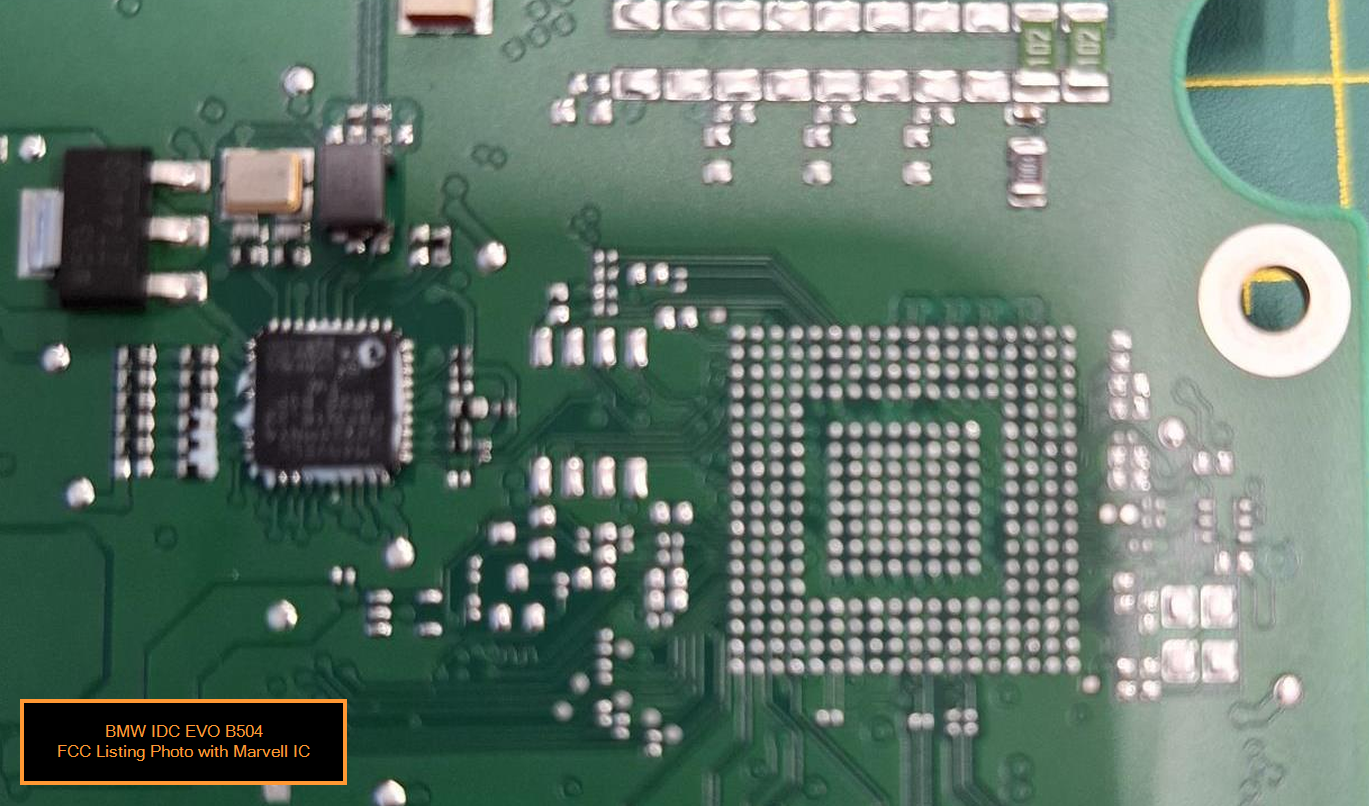
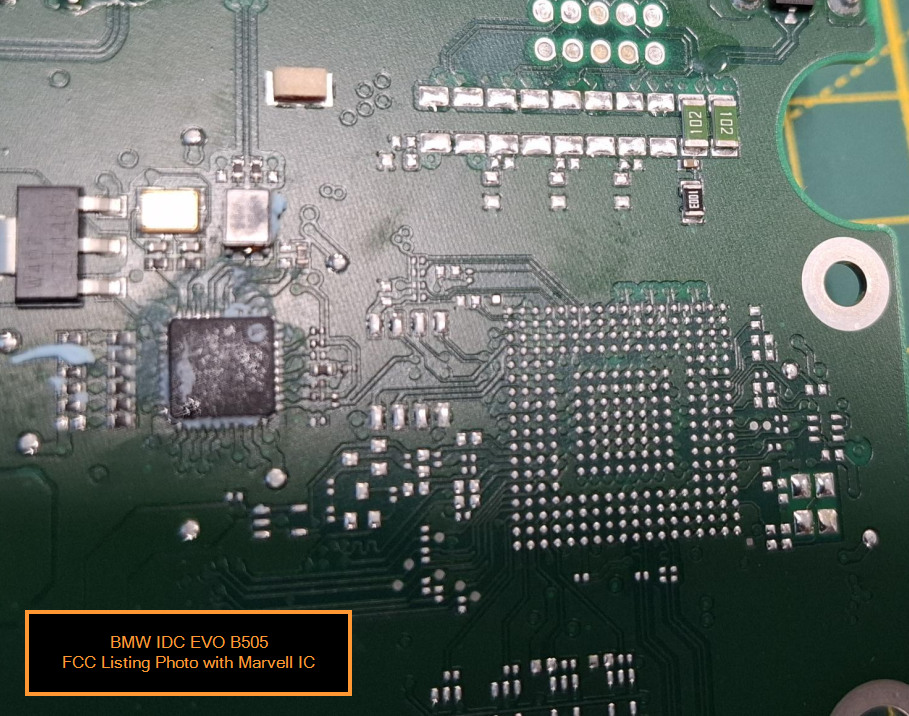
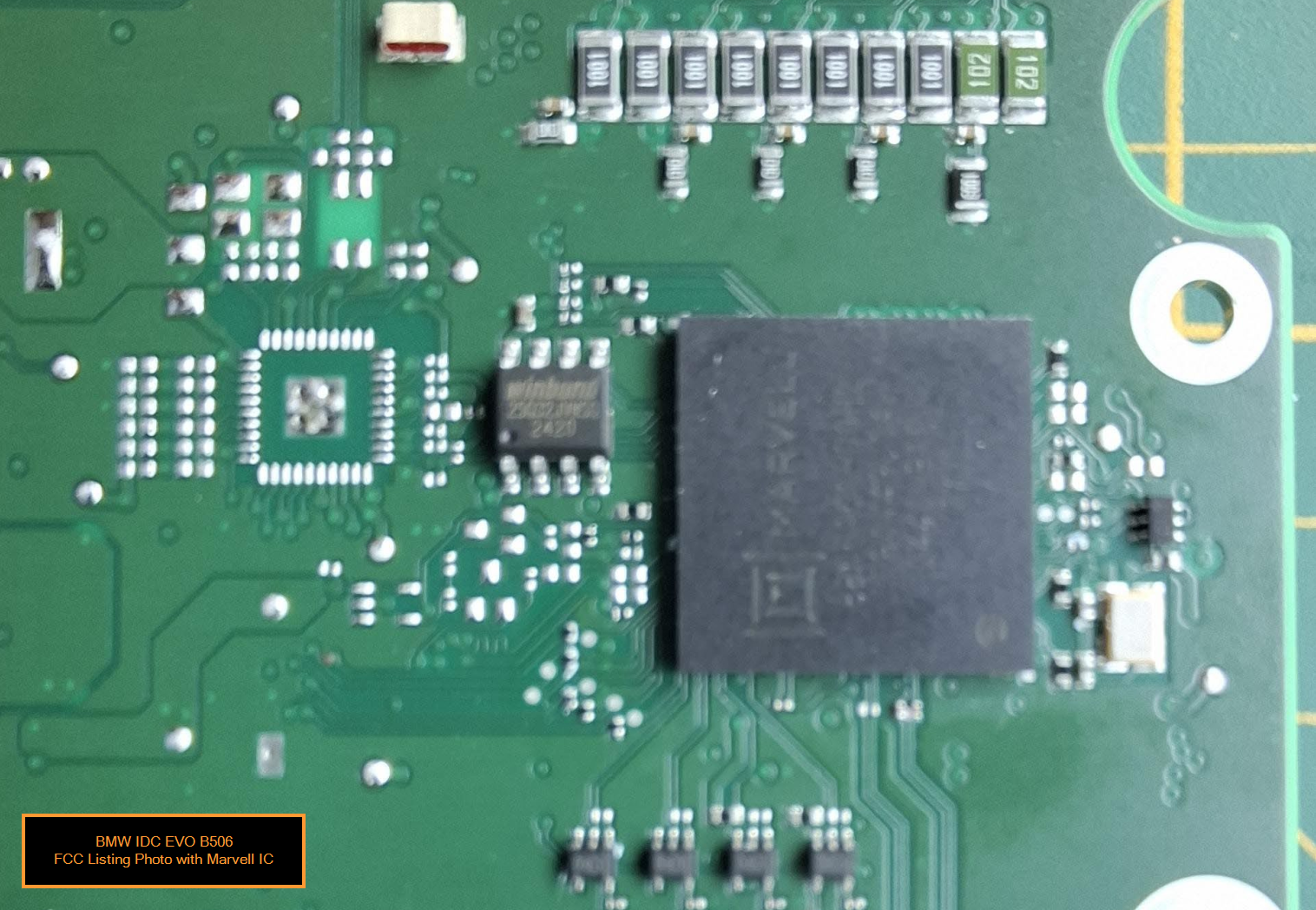
The right side of the board seems to hold the automotive ethernet ICs. Unfortunately, the close-up photos from the FCC listing leave a lot to be desired - the blur is from the original photos, lol.
On the lower-end B504 and B505 boards, only a small Marvell IC is present - likely some sort of lower-end or less-powerful automotive ethernet PHY or switch, since it seems like they only feature a single gigabit automotive ethernet interface (1000BASE-T1). But on the B506 model, a much larger Marvell IC is present, along with a small little 8-pin chip next to it - maybe some EEPROM for storing configuration or routing information?
While I was unable to confirm the exact part numbers in use here, the tiny Marvell IC used on the B504 and B505 looks very similar to the Marvell/Infineon “BRIGHTLANE” Q2221MNVA 1000BASE-T1 PHY that was present in the older IDC23H infotainment system. It wouldn’t surprise me if it was the same part, or maybe a generation newer.
This photo of the Micron flash comes from Visteon’s MIC Giteki Japan filing.
Moving to the middle of the board, we have 128GB of Micron UFS 3.1 flash storage in a BGA153 form factor (part number: MTFC128GBCAVTC-AIT). UFS seems to be the new gold standard for automotive infotainment systems, and this is very similar to the flash found on the IDC23H. If you want to dump the flash on one of these, you’ll have to get your hands on a flash reader that supports UFS 3.1! They’re expensive right now, but hopefully the tools will get cheaper over time.
(As a side note: The 128GB size was what was used on the one FCC listing that I could actually see the part number on - it’s possible that variants will have different flash storage sizes, or have ICs from different manufacturers. I couldn’t read the part numbers for every device variant)
A few unknown ICs featured at the bottom of the board (photo from Visteon MIC Giteki Japan filing)
As for the last few ICs near the south side of the board: Unfortunately, none of the FCC listing photos I could find showed them in high enough resolution to determine a part number. They could be CAN or LIN transceivers, as I’m guessing this unit would have both (CAN to communicate with the gateway on the Body CAN bus, and LIN to communicate with things like the HVAC system), but that is currently unconfirmed. They could also be basic power switching and regulation ICs. Either way: another thing to identify with a hands-on teardown in the future!
The Full Component List
I’ve included a full list of major components that I was able to identify in the appendix of this post (section title: IDCEVO-EES25 - Major Components). Please check that out if you’d like more in-depth info on part numbers and whatnot!
IDCEVO-EES25-V - The Visteon Variant?
Now, the eagle-eyed among you may have noticed I referenced a “Visteon version” and Visteon’s filings in a few sections above. And Visteon ≠ Harman, so what gives?
Visteon’s separate FCC filing for the IDCEVO-EES25V
Well, it seems that this unit is produced by Visteon as well! I’m not sure why, and I’m not sure what Visteon’s overall contributions to the device are/were - so that’s still a mystery. But they have their own dedicated FCC listing, and they even have their own submission to the MIC Giteki Japan database!
FCC ID: NT8-IDCEVOEES25V
MIC Giteki Japan ID: 020-260058
Visteon’s device photos are locked from public access until 2026-12-29.
Unfortunately, their listings are relatively sparse. Because they filed their FCC application back on 2026-07-02, the device photos have short-term confidentiality until 2026-12-29. So, perhaps an update to this post will come then, or a new post! Judging by filenames alone, it seems like they will have the same three variants as Harman:
"Internal photos_IDCEVO_B505.pdf”
“Internal photos_IDCEVO_B504.pdf”
“Internal photos_IDCEVO_B506.pdf”
The same three variants: B504, B505, and B506. Only time will tell if they’re truly identical, or what the nature of them is!
A Hypothesis on Visteon’s Involvement
I saw this unit was specifically called the “Infotainment Domain Controller” - I believe Visteon builds BMW’s current-generation body domain controller or ”basis central platform” (the BCP-01, teardown coming soon!) so it could make sense that BMW would involve Visteon in the development of other major modules and domain controllers as well. After all, all of this device’s communications and buses likely pass through Visteon’s other unit, so they’re the perfect people to partner with when engineering and debugging a new module. That being said, that’s just a hypothesis - I have no idea what the actual nature of the relationship is.
An interesting note on Garmin
It also appears that BMW has ended their infotainment relationship with Garmin, perhaps? I was surprised when I did a teardown of the IDC23H and found it was manufactured by both Harman and Garmin, as I hadn’t seen Garmin’s name involved with high end infotainment products before. That being said, their name is absent on this latest generation - and that doesn’t seem like a great sign.
Again, I have no idea why Garmin was involved in the IDC23H generation but not the IDC EVO generation, and I have no idea why Visteon’s name has popped up now either. OEMs swap back and forth between suppliers all the time, and it’s possible that Visteon just checked BMW’s boxes better than Garmin did. Cost savings, management direction, who knows. But with Harman as the decades-long infotainment builder for BMW, it’s always interesting seeing what other names pop up and fall away alongside them.
Conclusion and Future Plans
OSINT is fun! You can learn a lot about a new device, even if you don’t have the funds to acquire one :D
I had a blast digging into various regulatory databases to look for filings or references to the new IDC EVO devices. Makes me feel like a significantly less cool Columbo.
Unfortunately, these kinds of listings don’t contain any information about software, so that will have to come in the future. I know BMW states that “Operating System X” is based on AOSP, but that’s about all of the information they’ve divulged… I want to poke at the firmware! That will come in a future post, once I buy an IDC EVO and a UFS 3.1 reader.
Also, not to bring up a BRAND NEW topic in the Conclusion, buuut: you may have caught it in the original Harman FCC listing screenshot, but there was an additional new Harman IDC unit that they JUST submitted to the FCC: The BMW/Harman T8GIDCEVORSE. The “IDC EVO RSE” seems to be the new IDC EVO-generation “Rear Seat Entertainment” (RSE) - basically, the module that would drive seat-back screens and multimedia for back-seat passengers.
The new IDC EVO RSE module, courtesy of Harman’s MIC Giteki Japan application.
Harman only juuust filed this FCC application on 2026-09-21, so unfortunately the short-term confidentiality on device photos doesn’t expire until 2027-02-18 in the United States. BUT: for some reason, their MIC Giteki Japan filing doesn’t have any confidentiality window built-in, so you can actually check out pictures of the device there… maybe an exercise for the reader? If you’re curious, go look around for “020-260140_01_002.pdf” :D
Maybe I’ll do a teardown or analysis of that unit in the future - it seems to run the same Samsung V720 SoC, with an S32K144 on the back of the PCB, just like the main IDC EVO. Could be an interesting thing to poke at and write a post about!
Anyways, that’s all I’ve got for now. As always, thank you for reading, and I’ll recite the eternal MOTD:
Do it for fun, or don’t do it at all. Happy hacking!
Appendix
The appendix here holds the footnotes, side comments, and raw data dumps that I didn’t want to include in the main body of the blog post above. Enjoy!
Yellow Heading Color: #ffd300
IDCEVO-EES25 - Major Components
As a summary, this is a list of all of the major components I’ve identified on the IDCEVO-EES25 unit:
Processors
Samsung V720 System on Chip (SoC) (Exynos Auto 7) (website)
SAMSUNG V720B95 B
ARM H2436 AZNZG
Unfortunately there’s almost no public info and no datasheets for this SoC (yet).
SoC RAM ICs:
Micron 8GB Automotive LPDDR5X SDRAM (website)
4LC47 D8DPH
Decoded Part Number: MT62F1G64D4EK-023
SoC ISSI NOR Flash:
ISSI IS25WX128 - 128Mb NOR Flash (datasheet)
JHLA3
P3M037Y9
SoC Power Management ICs:
I’m guessing the two small ICs on either side of the main Samsung chip are power management ICs
Unfortunately, their part numbers were blurry and I couldn’t find any datasheets online. So they’ll remain a mystery…
NXP S32K144 ARM Cortex-M4F General Purpose MCU (datasheet)
Note: The markings on this IC are blurry as heck, so this isn’t 100% confirmed.
FS32K144UAVL4
?N57U
QVL2434C
Networking
Infineon CYW89570 2×2 Wi-Fi 6/6E and Bluetooth 6.0 Combo for Automotive Applications (datasheet)
CYW89570
CFFBG
2537 C 29
CYP 619893
THA
H04SX3
Large Marvell IC / EEPROM: Unknown
Likely some sort of Automotive Ethernet switch (on the B506 variant)
Small Marvell IC: Marvell / Infineon BRIGHTLANE Automotive 1000Base-T1 PHY (datasheet)
Q2221MNVA
Note: This is an assumption based on the gigabit IC used on the IDC23H + the extremely blurry PCB photo, lol.
Not confirmed!
Storage
Micron 128GB UFS 3.1 Flash Storage (website)
5AA22 AM022
Decoded part number: MTFC128GBCAVTC-AIT
Frequency Spectrum Information (IDCEVO-EES25)
Bluetooth - 2,402 - 2,481 GHz <10dBm
WLAN: 2.5 GHz (2.402 - 2.482 GHz) <10dBm
WLAN: 5 GHz (5.170 - 5.250 GHz) <14dBm
WLAN: 5 GHz (5.735 - 5.835 GHz) <14dBm
WLAN: 6 GHz (5.5925 - 7.125 GHz) <15dBm
Car Derivatives (“Derivates”)
There was also this interesting “Car Derivates” comparison table in the User Manual document included in their FCC filing. It seems like this might be a comprehensive list of the various vehicles that are planned to get this infotainment platform - I’ve included the list in the appendix of this post in plaintext so its easier to parse.
The model comparison table included in the IDCEVO-EES25 FCC filing user manual.
Below is the full plaintext list of vehicle model codes that will see this head unit, according to the “Car Derivates” table included in the User Manual:
RR45
RR41
RR40
G60 LCI
G61 LCI
G68 LCI
G70 LCI
G72
U10 LCI+
U11 LCI+
NA0
NA5
NA6
NA7
NA8
G50
G58
G66
G65
G67
G69
G78